A sewage backup can cause mold within 24 to 48 hours on materials that stay wet. Mold hides inside wall cavities, under baseboards and beneath flooring where sewage wicked in, and it comes with bacterial contamination that clean-water mold does not. Removing soaked porous materials, disinfecting what remains and drying the structure until moisture readings return to normal stops it.
How Fast Does Mold Grow After a Sewage Backup?
Mold can start growing within 24 to 48 hours on materials that stay wet after a sewage backup. The EPA advises drying water-damaged areas and items within 24-48 hours to prevent mold growth (EPA), and the CDC gives the same window for drying or removing wet items (CDC).
The EPA frames that window as a guideline, not a guarantee. Materials dried within it usually stay mold-free, but a cool, dark wall cavity can grow mold sooner, and a fast-dried surface can still hide a wet core.
Gilbert’s dry air helps exposed surfaces dry quickly. It does little for the inside of a wall or the pad under a floor, where water is sealed away from the air.
Where Does Mold Hide After a Sewage Backup?
Mold hides inside wall cavities, under baseboards, beneath vinyl and carpet, and under cabinets where sewage wicked in and stayed wet. These spots stay wet long after the room looks dry.
- Wall cavities: drywall wicks water upward, and the back face never sees air
- Baseboards: sewage runs underneath and soaks the bottom edge of the drywall
- Vinyl and laminate flooring: the plank traps water against the slab
- Carpet pad: holds water like a sponge under a dry-feeling carpet
- Cabinet bases and toe kicks: particleboard swells and stays wet behind the kick plate
- Shared walls: in townhomes and patio homes, water crosses into the neighbor’s wall
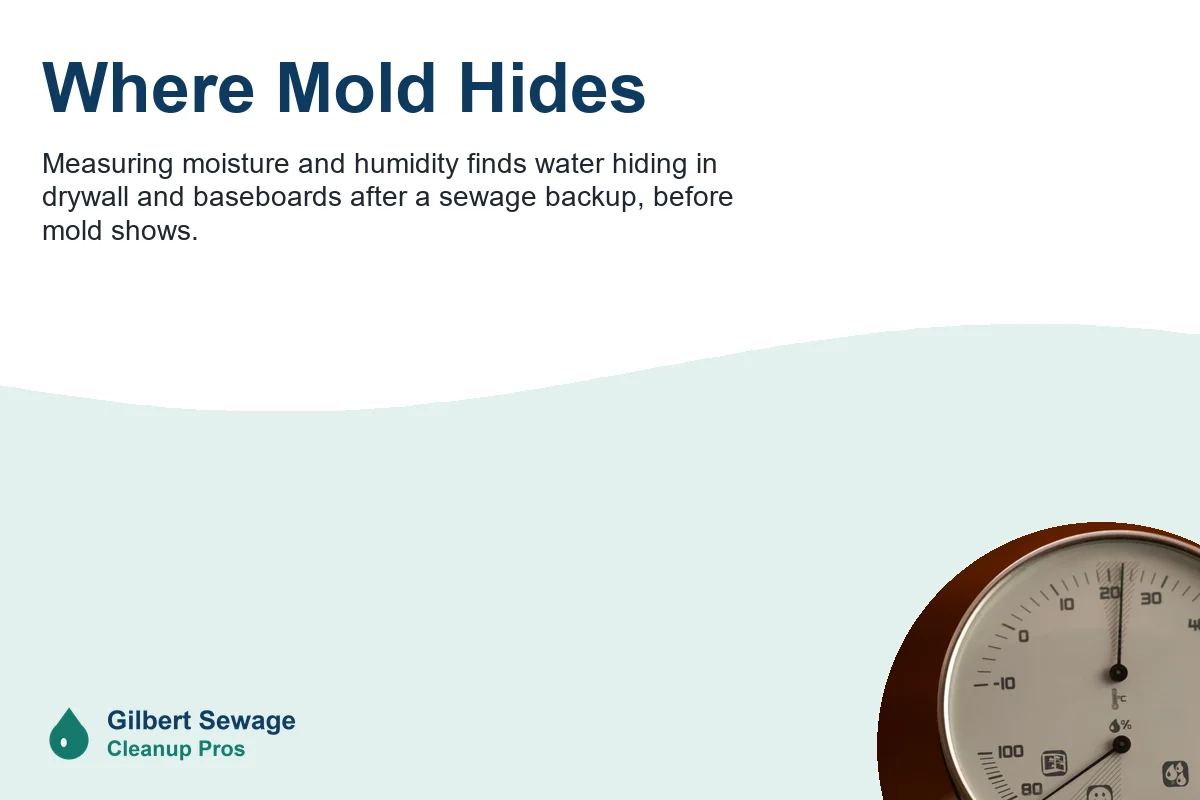
Every one of these spots needs a moisture reading, not a visual check. A moisture meter shows water the eye cannot see.
Can mold grow inside walls after a backup?
Yes, mold grows inside walls when sewage wicks into the drywall and the cavity stays wet. The paper backing of drywall feeds mold, and the sealed cavity keeps humidity high. Moisture readings at the base of the wall show whether the cavity needs opening.
Is Mold From Sewage Worse Than Mold From Clean Water?
Mold from a sewage backup comes with bacterial contamination as well, so affected porous materials are removed rather than cleaned (IICRC S500). Sewage is Category 3 water under the IICRC S500 standard, the most contaminated class. Mold from a clean supply-line leak grows on a material that was otherwise clean.
That difference changes the fix. Clean-water mold on a small area can sometimes be cleaned off a hard surface, but sewage-soaked drywall, insulation and carpet come out regardless of whether mold is visible yet.
How Do You Stop Mold After a Sewage Backup?
You stop mold after a sewage backup by removing soaked porous materials, disinfecting what remains and drying the structure until moisture readings return to normal. Each step depends on the one before it.
- Remove carpet, pad, soaked drywall and insulation within the first day.
- Clean hard surfaces with detergent, then disinfect them.
- Open wall cavities where readings show trapped water.
- Dry the room with air movers and a dehumidifier, keeping relative humidity below 60% (EPA).
- Measure moisture daily until readings match a dry reference spot.
The EPA recommends indoor relative humidity below 60%, ideally between 30% and 50% (EPA). The drying equipment used in sewage cleanup explains how air movers, dehumidifiers and meters work together.
Does bleach kill mold on drywall?
No, bleach does not reach mold growing inside drywall, because the water carries it into the paper while the chlorine stays on the surface. Moldy drywall is cut out and replaced. Bleach belongs on hard, non-porous surfaces after they have been cleaned.
What a Musty Smell After Cleanup Tells You
A musty smell after cleanup is the first sign that drying failed somewhere. The EPA notes that a house not dried properly develops a musty odor signifying microbial growth (EPA). Musty or sewage smells after cleanup each point to a different hidden source.
Why Does a House Still Smell Musty After a Backup?
A musty smell after a backup means moisture or mold remains somewhere in the building, even when the visible surfaces look clean. The source is usually a wall cavity, the underside of flooring or a cabinet base.
Follow the smell to its strongest point and take moisture readings there. A high reading means the material comes out.