Sewage cleanup in Gilbert, AZ runs $7 to $14 per square foot of affected area, with the final price set after an inspection. Cost rises with the area affected, the flooring and wall materials, how long the sewage sat and the days of drying needed. Cleanup is priced separately from rebuilding drywall and flooring, and homeowners insurance pays only with a backup endorsement.
What Is the Price per Square Foot?
Sewage cleanup in Gilbert costs $7 to $14 per square foot of affected area on most jobs, and the final price comes from an inspection. For most homes, that works out to about $2,000 to $10,000 for the whole job. The low end fits a contained backup on tile; the high end fits a backup that soaked carpet and drywall across several rooms.
“Affected area” means the floor and wall area the sewage reached, not the size of the house. A 2,500-square-foot home with a backup confined to one bathroom pays for the bathroom and any wall it wicked into.
No company can give a firm number over the phone. The inspection measures where moisture traveled, and water often spreads further under baseboards and into walls than the visible stain shows.
What is not included in a cleanup quote?
A cleanup quote does not include plumbing repair, rebuild, contents cleaning or mold remediation found once walls are opened. Each of these is a separate line or a separate trade.
- Plumbing repair: clearing the line, camera inspection and pipe work, billed by the plumber
- Rebuild: new drywall, paint, flooring, baseboards and cabinets after drying
- Contents cleaning: washing, packing out or disposing of furniture and belongings
- Mold remediation: extra containment and removal if mold is already growing inside walls
Ask the company which of these it handles and how each is priced. Knowing the boundaries up front prevents surprise invoices later.
What does the per-square-foot price include?
The per-square-foot price includes extraction, removal of contaminated materials, cleaning, disinfection and structural drying of the affected area. A sewage cleanup quote usually lists these line items:
- Emergency response: the crew’s arrival and first assessment
- Extraction: pumping or vacuuming standing sewage
- Containment: plastic barriers that keep contamination out of clean rooms
- Material removal: cutting out carpet, pad, drywall, insulation and baseboards
- Disposal: bagging and hauling contaminated debris
- Cleaning and antimicrobial treatment: scrubbing and treating the surfaces that stay
- Drying equipment: air movers, dehumidifiers and air scrubbers, often billed per day
- Moisture monitoring: daily readings until the structure reaches its dry standard
Ask for these items itemized. An itemized quote lets you see which parts of the job drive the price and compare companies line by line.
Why does an inspection come before a price?
An inspection comes before a price because the affected area is almost always larger than the visible stain. Technicians take moisture readings at the base of walls, along baseboards and across the floor, and some use a thermal camera to trace where water traveled. The measured area, not the stain, sets the square footage on the quote.
What Does Cleanup Cost for Each Type of Backup?
Cleanup cost rises with the area affected, from a half bath to several rooms or a shared wall. The table applies the $7 to $14 range to common backup sizes in Gilbert homes.
| Affected area | Example space | Low ($7/sq ft) | High ($14/sq ft) |
|---|---|---|---|
| 50 sq ft | Half bath or laundry closet | $350 | $700 |
| 100 sq ft | Full bathroom | $700 | $1,400 |
| 250 sq ft | Bathroom plus hallway and bedroom edge | $1,750 | $3,500 |
| 500 sq ft | Several rooms on one side of the house | $3,500 | $7,000 |
| 1,000 sq ft | Most of a single-story home’s living area | $7,000 | $14,000 |
Many jobs carry a minimum charge for the crew’s visit, so a very small backup can cost more per square foot than the table shows. Floor drain and toilet backups usually start in the first two rows and grow into the third if the sewage sat.
Here is how the arithmetic works on a real layout. A full bathroom of about 100 square feet that backed up onto tile prices near $700 to $1,400. If the same backup ran under the door and wicked into a hallway and a bedroom closet, the affected area can pass 250 square feet, which moves the job to $1,750 to $3,500 before any rebuild.
Shared walls add area that is easy to miss. In townhomes and patio homes, sewage that wicks through a shared wall puts square footage on both sides into the job.
Commercial kitchens, offices and HOA common rooms follow the same per-square-foot method but usually measure larger. Their pricing is covered further down this page.
The 6 Factors That Raise or Lower the Price
The 6 factors that raise or lower the price are affected area, flooring and wall materials, how long the sewage sat, access, the drying time needed and whether the job is a home or a business. Two jobs of the same size can price very differently because of factors 2 through 6.
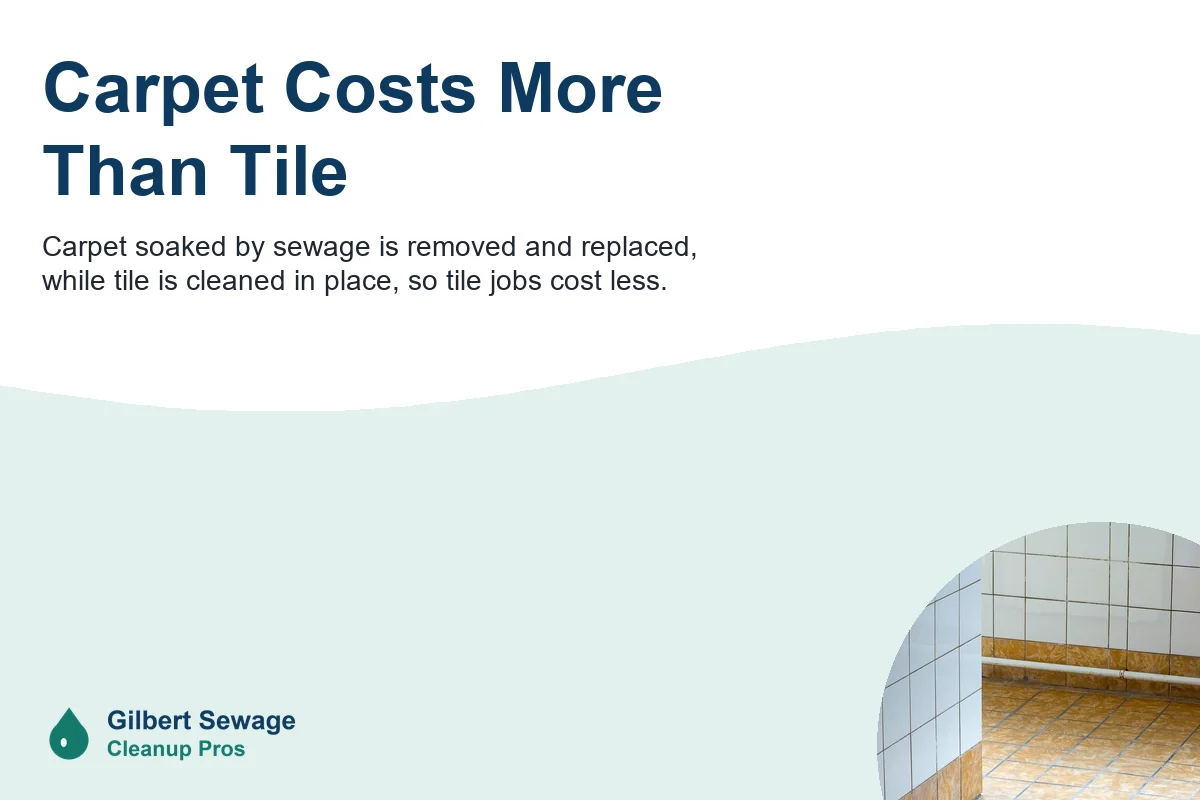
The difference shows up clearly between a tiled bathroom and a carpeted bedroom of the same size. The bathroom is extracted, scrubbed, disinfected and dried in place. The bedroom loses its carpet, pad and the bottom of its drywall, which adds removal, disposal and rebuild.
- Affected area: the square footage the sewage reached, including walls it wicked into.
- Flooring and wall materials: carpet, pad and drywall mean removal and disposal; tile and concrete mean cleaning in place.
- Time the sewage sat: every hour lets it spread further into porous materials.
- Access: cabinets, built-ins, tight bathrooms and heavy furniture add labor.
- Drying time needed: more drying days mean more equipment rental and monitoring visits.
- Home or business: commercial jobs add after-hours work, larger spaces and extra documentation.
The first 3 factors drive most of the difference between a low and a high quote. They also explain why a fast response costs less.
Does access change the price?
Yes, access changes the price, because crews bill for the time it takes to reach wet materials. Built-in cabinets, a vanity over the wet area or a washer and dryer in a closet all have to be moved or removed before drying can start. Clear rooms and an open path for hoses and equipment shorten the job.
How many drying days does a job take?
A sewage job takes several days of drying in most cases, confirmed by daily moisture readings rather than a fixed schedule. Removing soaked drywall and flooring usually shortens drying, because exposed framing releases water faster. Equipment rental and monitoring visits are often billed per day, so drying days show up directly on the invoice.
Does carpet cost more to clean up than tile?
Yes, carpet costs more to clean up than tile, because sewage-soaked carpet and pad are removed and disposed of rather than cleaned (IICRC S500). Tile and sealed concrete are scrubbed and disinfected in place. Many Gilbert homes have tile in bathrooms and laundry rooms, which keeps those backups toward the low end.
Vinyl plank and laminate sit in between. The planks themselves resist water, but sewage runs through the seams and gets trapped against the slab, so they are usually lifted to dry the floor underneath.
Why does the time sewage sat matter?
The time sewage sat matters because it decides how far contamination spreads into porous materials. Drywall wicks water upward and flooring seams pull it underneath, so a backup found in an hour stays smaller than one found after a weekend away. The EPA advises drying wet materials within 24-48 hours to prevent mold growth, and mold adds removal work once it starts (EPA).
Heat speeds the spread. Bacteria multiply faster in a warm house, and Gilbert homes left closed up in summer give a backup ideal conditions while the owners are away.
Is Cleanup Priced Separately From Rebuild?
Yes, cleanup and rebuild are priced separately: cleanup removes and dries, while rebuild replaces drywall, flooring and trim afterward. Cleanup leaves the room clean, dry and open, with drywall cut out above the wet line and flooring removed. Rebuild puts it back together.

Some companies handle both; others hand the rebuild to a general contractor. Either way, expect 2 quotes or 2 sections on one quote. Rebuild prices depend on the finishes you choose, such as tile versus vinyl plank, so they are quoted once the room is open and dry.
Rebuild cannot start until drying is confirmed. Closing a wall over damp framing traps moisture and restarts the mold clock, so the moisture log is the green light for rebuild.
Plumbing repairs are a third, separate cost. Clearing the main line, a camera inspection and any pipe repair are billed by the plumber, not the cleanup company.
Insurance treats the two phases the same way when a backup endorsement applies: both cleanup and rebuild count toward the endorsement’s limit. Ask the cleanup company for a written scope of what was removed, because the rebuild estimate depends on it.
How Do Commercial Cleanup Costs Compare?
Commercial cleanup costs follow the same per-square-foot logic, with added cost for after-hours work, larger areas and business documentation. A restaurant backup often has to be cleaned overnight so the kitchen can reopen. Offices and retail spaces bring larger open floors and commercial carpet tile.
HOA common areas, such as clubhouses and shared laundry rooms, add coordination with the board and the management company. Commercial jobs also need records that satisfy the property’s insurer and, for food businesses, the county health inspector.
Businesses also lose income while closed, which no cleanup quote covers. Commercial property policies and business interruption coverage handle that separately, so business owners should call their agent the same day.
Multi-unit buildings add a question of who pays for which unit. A backup that crosses from one condo into the next is often split between owners, the HOA and their insurers, so each area is measured and documented separately.
How do you keep the cost of a sewage cleanup down?
You keep the cost of a sewage cleanup down by stopping water use right away, calling for help the same day and keeping the affected room closed off. Fast response keeps sewage out of drywall and flooring that would otherwise need removal. Clearing the main line before the cleanup prevents paying for a second backup.
Moving furniture out of the dry rooms, clearing a path for equipment and having photos ready for the insurer also save time on site. Skipping removal of soaked materials to save money backfires, because it brings odor and mold back later.
A clear decision on what to keep also saves time. Agreeing up front that soaked carpet, pad and particleboard furniture go lets the crew remove them in one pass instead of waiting for approvals.
How Insurance Changes What You Pay
The figures above are what the job costs, not always what you pay. Whether a policy covers the backup decides how much of the bill stays with you. The guide to how homeowners insurance treats sewage backups covers endorsements, limits and claims.
Will Homeowners Insurance Cover the Cost?
Homeowners insurance covers the cost only with a sewer or water backup endorsement, since standard policies exclude backups (Insurance Information Institute). The endorsement pays up to the limit you chose, minus your deductible. Many homeowners learn they lack it only after a backup.
Check your declarations page now for a line that mentions water backup or sewer backup. If it is missing, the endorsement can usually be added at renewal or mid-term, but it does not cover a backup that already happened.
The deductible still applies to a covered backup, and the endorsement limit caps the total payout. Some insurers pay the cleanup company directly once the claim is approved; others reimburse the homeowner after the invoice is paid, so ask your adjuster which applies before work starts.