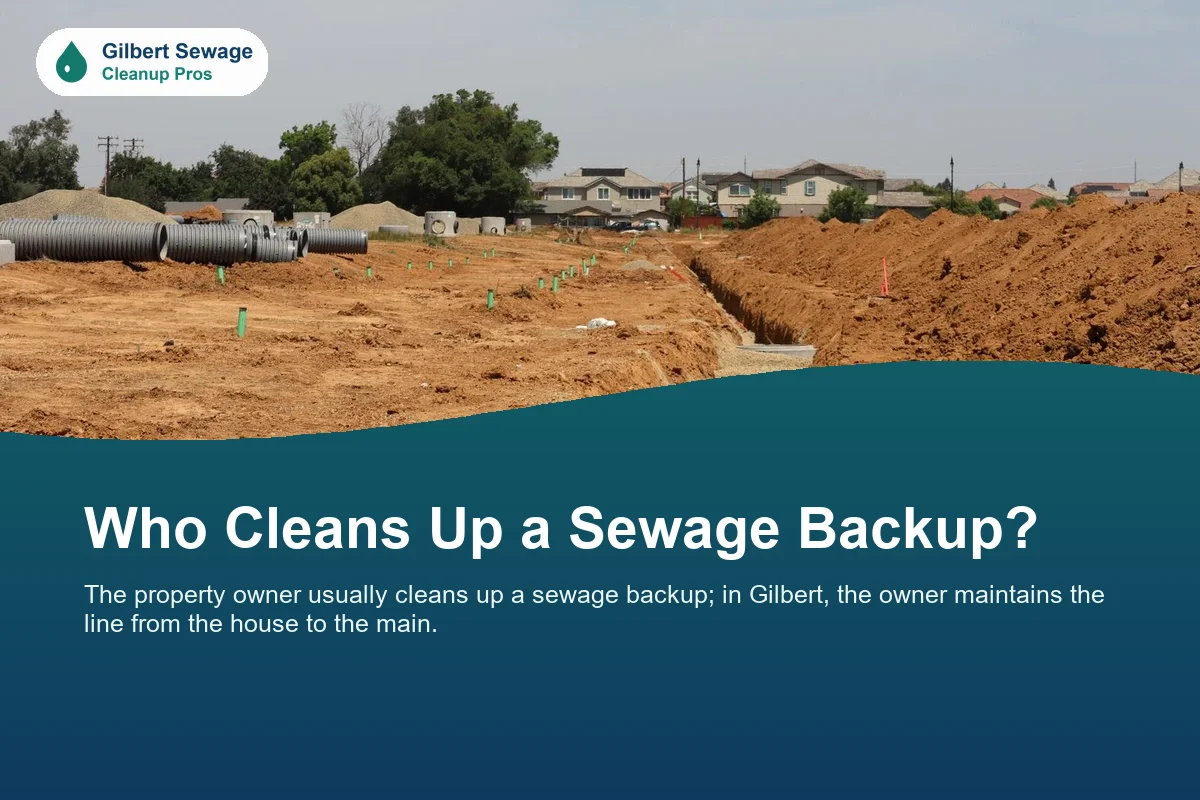
The property owner usually cleans up and pays for a sewage backup inside the home. In Gilbert, the owner’s sewer line runs from the house to the public main, while insurance pays only when the policy carries a backup endorsement. In rentals, condos and HOAs, responsibility follows who owns the pipe or space where the blockage happened, as set by the lease or HOA documents.
Who Is Responsible for Cleanup Inside the Home?
The property owner is responsible for sewage cleanup inside the home in most cases, whatever caused the backup. Sewage that comes up through a floor drain or toilet lands on private property, and cleanup of private property falls to its owner. Insurance can reimburse the cost, but the decisions and the first calls are the owner’s.
That holds even when the blockage sits outside the house. The cause decides who repairs the pipe; it does not change who cleans the floor.
Where Does the Homeowner’s Sewer Line End?
The homeowner’s sewer line runs from the house to the point where it joins the public main, often marked by a cleanout near the property line. Gilbert’s town code defines this “individual sewer line” as the pipe from its connection at the building to its connection at the main sewer line, including the sewer tap (Town of Gilbert Code, Chapter 66). The code requires all users to clean, unstop and maintain that line and to remove root intrusions along its entire length (Town of Gilbert Code, Sec. 66-251).
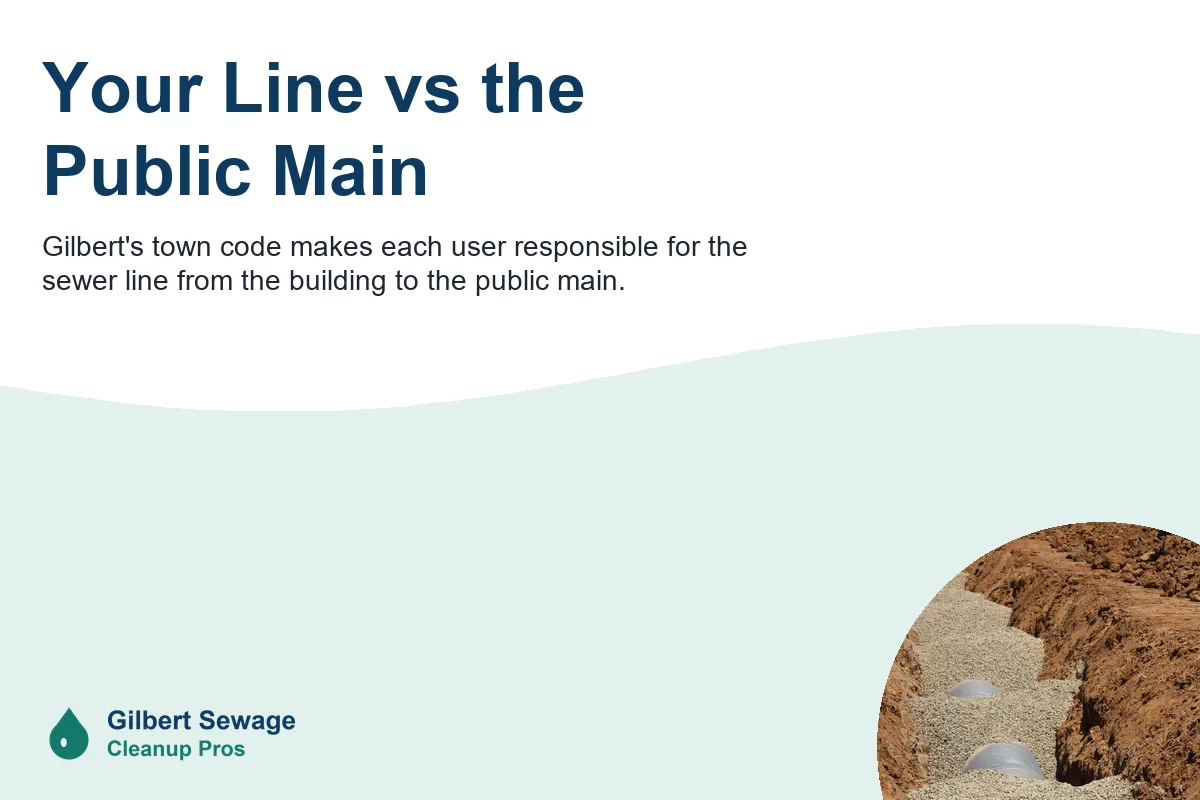
The public main is the larger pipe under the street that collects every home’s line. Gilbert’s Wastewater Division maintains the public collection system, including manholes and mains.
Who fixes a blockage in the line under the yard?
The property owner clears a blockage anywhere in the individual sewer line, because the town code assigns cleaning and unstopping of the whole line to the user (Town of Gilbert Code, Sec. 66-251). A licensed plumber clears it, usually through the cleanout. A camera inspection then shows whether roots, a crack or a sag caused it.
Repairs split at the property line. The owner repairs the on-property section, while the town coordinates and makes repairs to the off-property section and can bill the owner if the owner’s actions caused the damage (Town of Gilbert Code, Sec. 66-251). Every repair must meet town permitting and construction standards and pass inspection before the line returns to service.
Does Insurance Pay for Sewage Cleanup?
Insurance pays for sewage cleanup only when the policy carries a sewer or water backup endorsement, since standard homeowners policies exclude backups (Insurance Information Institute). The endorsement is an add-on with its own limit, and many homeowners do not know whether they have it. The guide to homeowners insurance and sewage backups explains limits, exclusions and claims.
When the backup started in the public system rather than your own line, your policy still pays first if you carry the endorsement. Your insurer can then pursue the responsible party for repayment.
Who Is Responsible in Rentals, Condos and HOAs?
In rentals, condos and HOAs, responsibility follows who owns the pipe or the space where the blockage occurred, as set by the lease or the HOA documents. Gilbert has many HOA communities, so the CC&Rs often decide shared-line cases.
| Property type | Usually responsible | Where to check |
|---|---|---|
| Rented house or apartment | Landlord, unless the tenant caused the clog | Lease; A.R.S. 33-1324 |
| Condo unit | Unit owner for lines serving only that unit | Condo declaration and CC&Rs |
| HOA common line | HOA for lines serving more than one unit | CC&Rs and HOA maintenance chart |
| Townhome shared wall | Owner of the unit where the backup started | CC&Rs; both owners’ insurance policies |
These are common patterns, not legal rules for every community. The governing documents for each property control.
Is the landlord responsible for a sewage backup?
Yes, the landlord is responsible in most rentals, because Arizona law requires landlords to keep plumbing and sanitary facilities in good and safe working order (A.R.S. 33-1324). A tenant who caused the clog, such as by flushing wipes, can be charged for the repair under many leases. Renters insurance covers the tenant’s belongings only if it includes backup coverage.
Does an HOA pay for a backup in a shared line?
An HOA pays when the blockage is in a line its documents define as common, such as a line shared by several units. A blockage in the line serving one unit usually belongs to that unit’s owner. The CC&Rs and the HOA’s maintenance chart set the boundary.
What Sewage Cleanup Costs When You’re the One Paying
When no policy or landlord covers the job, the cleanup bill lands on the owner. Knowing what drives that bill helps you read a quote. The guide to what sewage cleanup costs in Gilbert covers the price range and the factors behind it.
What Drives the Cost of a Sewage Cleanup?
The cost of a sewage cleanup is driven by the affected area, the materials removed and the days of drying. A small tile bathroom costs far less than a backup that soaked carpet and drywall across several rooms.
Time adds cost too. Sewage left standing spreads into more materials, which means more removal and more drying days.