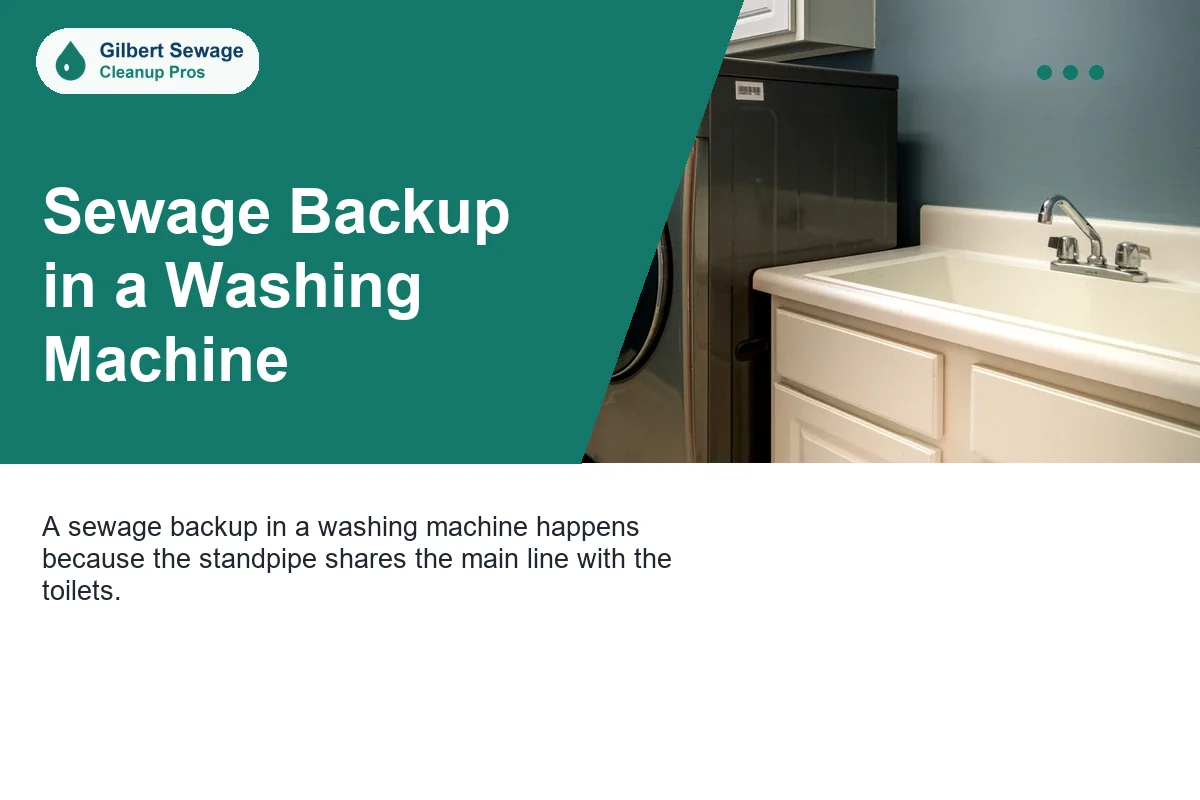
A sewage backup in a washing machine happens because the washer’s standpipe shares the main line with the toilets, so a main-line blockage pushes sewage up its drain. Cut power and water and stop every drain in the house first. The drum, gasket and hose can then be cleaned and disinfected, but water that reached the motor or control board points toward replacement. Clothes inside can be washed hot and separately, once the main line is cleared.
Why Sewage Comes Up Through a Washing Machine Drain
Sewage comes up through a washing machine drain because the standpipe connects to the same main line as the toilets, so a main-line blockage pushes water back up its lowest open point. The standpipe is the open vertical pipe the washer’s drain hose hooks into. Below it sits a P-trap, a U-shaped bend that holds water to block sewer odors.
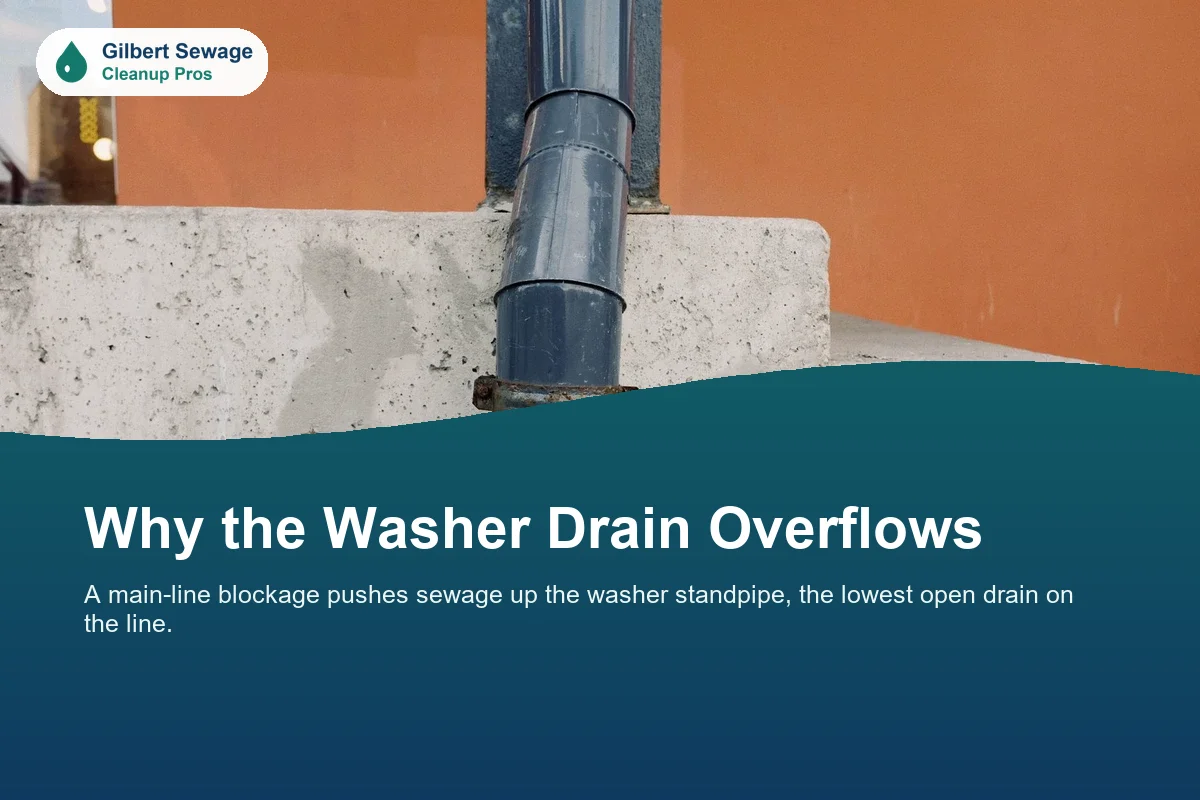
All of a home’s drains feed one main line that runs to the street. When that line clogs, wastewater from every fixture backs up and exits wherever the opening sits lowest or the pipe gives the least resistance. Laundry rooms on a slab often share that low point with floor drain and toilet backups.
That is why the washer backs up while the bathroom sink does not. The sink drains a small volume slowly, while the washer pushes a large surge into a line that has no room for it.
Many Gilbert homes have the laundry room on the ground floor near the garage, which puts the standpipe close to the point where the main line leaves the house. That location makes the washer one of the first places a main-line clog shows up.
Can a washing machine cause a sewage backup?
No, a washing machine cannot create sewage, but its large drain volume exposes a partial blockage. A washer pumps out a full drum of water in one fast surge, far faster than a sink drains. A line that copes with a shower overflows when that surge hits a clog.
Why does the toilet gurgle when the washer drains?
The toilet gurgles when the washer drains because the surge pushes air back through a partly blocked or poorly vented line. The air escapes through the nearest water seal, which is often the toilet bowl. Gurgling is an early warning that the main line is narrowing.
What to Do First When Sewage Reaches the Washer
When sewage reaches the washer, you cut power at the breaker, shut the water supply and stop using every drain in the house before touching the machine. Water and electricity in the same spot is the first danger, and sewage is the second.
- Switch off the washer’s circuit breaker, and leave the panel alone if you would stand in water to reach it.
- Close the hot and cold supply valves behind the washer.
- Stop all water use in the house: no flushing, showers or dishwasher cycles.
- Photograph the drum, floor and standpipe before you clean anything.
- Call a plumber to clear the main line before the washer runs again.
Running the washer before the line is cleared pushes a second backup onto the same floor. Clearing the line comes before every cleaning step.
Should you run the washer to drain the sewage out?
No, do not run the washer to drain it, because the pump sends the sewage straight back into the blocked line. The water has nowhere to go and comes back up the standpipe. Bail or vacuum the drum instead, after the power is off.
How to Clean a Washing Machine After a Sewage Backup
To clean a washing machine after a sewage backup, you remove debris, scrub the drum and door gasket with detergent, run a hot cycle with a disinfectant rated for the machine, and dry it with the door open. Check the manufacturer’s manual first, because some brands prohibit bleach or specific cleaners in the drum.
Prepare before you start: rubber boots, waterproof gloves, goggles, a bucket, a stiff brush, detergent and heavy-duty trash bags. Bail or vacuum standing water from the drum with a wet/dry shop vac, then pull the filter or coin trap and empty it into a bag.
How do you sanitize the drum and gasket?
To sanitize the drum and gasket, you scrub them with detergent first, then disinfect, then run an empty hot cycle.
- Scrub the drum, the detergent drawer and the door glass with hot water and detergent.
- Pull back the front-loader door gasket and scrub inside every fold, where sewage collects.
- Wipe all surfaces with the disinfectant your manual allows, such as a bleach solution.
- Run the hottest empty cycle with the disinfectant your manual approves.
- Leave the door and the detergent drawer open until everything is dry.
Top-loaders follow the same steps without the gasket. Scrub under the agitator and around the rim, where residue hides.
Can bleach damage a washing machine?
Yes, undiluted or repeated bleach can damage rubber seals and some drum finishes, which is why the manual comes first. Many manufacturers approve a measured bleach dose or a washer-cleaning product for a cleaning cycle. Use only the amount and product the manual names.
Should the drain hose be replaced?
Yes, replace the drain hose, because sewage coats the inside and a scrub brush cannot reach it. A new hose costs little next to a second contamination. Disinfect the standpipe opening before the new hose goes in.
Can the Washer Be Saved, or Does It Need Replacing?
A washer can usually be saved when sewage stayed in the drum, but water that reached the motor, control board or pump points toward replacement. An appliance technician checks the electrical parts before the machine runs again.
| Sign | Likely outcome | Next step |
|---|---|---|
| Sewage stayed inside the drum | Saveable | Clean, disinfect and run an empty hot cycle |
| Sewage pooled under the machine | Saveable if the base stayed dry | Tilt and inspect the base and pump area |
| Water reached the motor or pump | Repair or replace | Appliance technician inspection |
| Water reached the control board | Often replace | Do not power on before inspection |
| Washer trips the breaker or smells burnt | Replace or repair | Leave unplugged and call a technician |
Repair costs on a control board often approach the price of a new washer. A technician’s written finding also supports an insurance claim.
Water near the electrical parts is also a safety question, not just a repair cost. A washer that got wet inside the cabinet stays unplugged until a technician clears it.
What About Clothes That Were in the Machine?
Clothes that touched sewage can be washed in hot water with detergent and a bleach rated for the fabric, separately from all other laundry. Seattle Public Utilities advises laundering cleanup clothes and shoes separately from other clothing (Seattle Public Utilities). Use a clean, disinfected machine or a laundromat for these loads.
Throw away items that cannot be washed hot, such as wool, silk and anything labeled dry clean only. Stuffed toys and pillows that absorbed sewage go in the trash.
Can shoes be saved after sewage contact?
Rubber boots and plastic shoes can be scrubbed and disinfected, while fabric and leather shoes that soaked up sewage are usually thrown away. Foam insoles absorb sewage the same way carpet pad does. Bag discarded items before they leave the laundry room.
When the Laundry Room Floor Needs Cleaning Too
A washer backup rarely stays inside the machine. Sewage that overflowed the drum or the standpipe soaks into baseboards, the bottom of drywall and any flooring seams. Cleaning the rest of the laundry room follows the same steps as any indoor backup.
How Do You Stop Sewage From Backing Up Into the Washer Again?
You stop repeat washer backups by clearing the main-line blockage and keeping grease, wipes and lint out of the drains. A camera inspection shows what caused the clog, such as roots, a belly in the pipe or a buildup of grease.
These 5 measures cut the chance of another washer backup:
- A main-line camera inspection after the first backup
- A lint trap on the washer drain hose
- A trash can for wipes, even ones labeled flushable
- A container for cooking grease instead of the kitchen sink
- A backwater valve, if a plumber confirms your line needs one
A backwater valve lets wastewater leave the house but closes when sewage flows backward. Not every slab home has a spot to install one, so a plumber assesses the line first.
Prevention is cheaper than a second cleanup. A washer backup is usually the first warning of a main-line problem, so treat it as a reason to have the line inspected even after the clog clears.